Culture
Auguste-François Perrinon: the abolitionist who made Saint-Martin his home
A profile of Auguste-François Perrinon (1812–1861), the Martinique-born polytechnicien and abolitionist who ran salt ponds on Saint-Martin with paid labour and spent his last years on the island.
By SXM Daily ·
Auguste-François Perrinon was a French abolitionist who helped carry out the end of slavery in the French Caribbean in 1848. Born in Martinique, he was tied to Saint-Martin for most of his adult life: he ran salt ponds on the island with paid workers, settled there in the 1850s and died there in 1861.
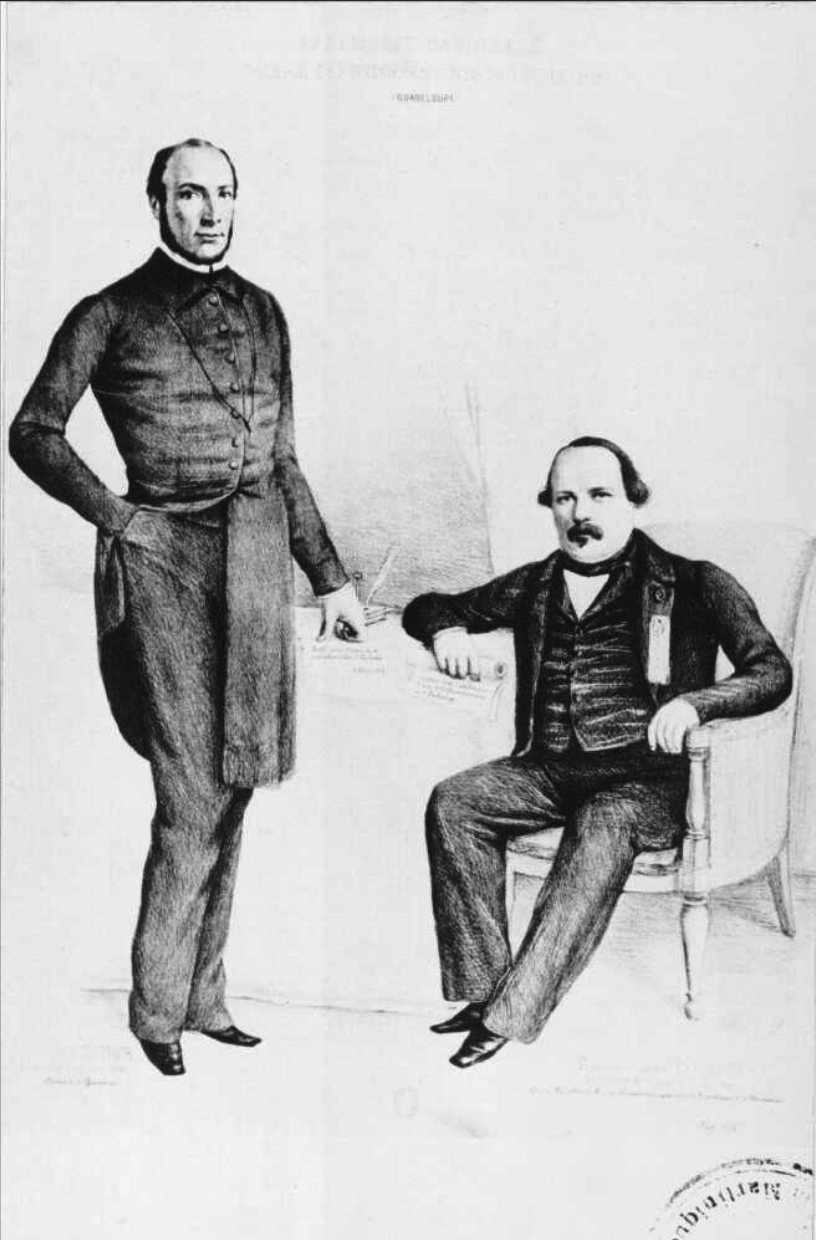
Victor Schœlcher (left) and Auguste-François Perrinon (right), c. 1848. Photo: Anonymous / Wikimedia Commons, Public domain
From Saint-Pierre to the École polytechnique
Perrinon was born on 28 August 1812 in Saint-Pierre, Martinique, so he was not a native of St. Martin. In 1832 he entered the École polytechnique, France's leading engineering school. The school's alumni review, La Jaune et la Rouge, and the Fondation pour la mémoire de l'esclavage both describe him as its first student of colour. Some sources write his name as François-Auguste Perrinon.
Salt ponds and paid labour on Saint-Martin
His link to Saint-Martin began in 1844, when he took an interest in a plantation with salt ponds on the island. Its workforce mixed enslaved people and free labourers, but under Perrinon everyone was paid and corporal punishment was abolished, according to the alumni review. In 1847 he published a pamphlet on the work of the salt ponds.
1848: emancipation
When France abolished slavery in 1848, Perrinon was named commissaire de la République. He then served as commissaire général of Martinique from June to November 1848, and he is remembered as the man who carried the emancipation decree to the island of his birth.
Deputy for Guadeloupe
From 1849 he sat in the Assemblée nationale législative in Paris as a deputy for Guadeloupe, alongside the abolitionist Victor Schœlcher, who appears with him in the portrait above.
Last years on Saint-Martin
After the coup d'état of 2 December 1851, Perrinon withdrew to Saint-Martin. He lived there until his death in January 1861 and is buried on the island.
Legacy
A collège in Fort-de-France and streets in Martinique and Saint-Martin carry his name. For Saint-Martin, his story ties the island directly to the wider history of abolition in the French Caribbean. Read more in SXM Daily's history of emancipation and the abolition of slavery in Saint-Martin.
Sources
- https://memoire-esclavage.org/biographies/auguste-francois-perrinon
- https://www.lajauneetlarouge.com/francois-auguste-perrinon-x1832-polytechnicien-antiesclavagiste/
- https://www2.assemblee-nationale.fr/sycomore/liste/21
- https://commons.wikimedia.org/wiki/File:Fran%C3%A7ois-Auguste_Perrinon.png
Source: https://memoire-esclavage.org/biographies/auguste-francois-perrinon
More in Culture
- Journées de l'architecture: Collectivité shows designs for Thelbert Carti stadium, Galisbay centre and Sandy Ground
- Sint Maarten, Saba and St. Eustatius sign agreement to research legacy of slavery
- Three Naatya Arts Center dancers perform in Guadeloupe on Saturday, 17 October 2026
- 'Under the Hood' volunteers bring newsletters, a book club and photography to Point Blanche and Miss Lalie Center